Tell us about the job
Takes about a minute. No obligation.
Sizing a heat pump in Dougherty County is not a catalog exercise. 125 severe weather events were recorded in Dougherty County, Georgia between 2015 and 2024. At that rate, severe weather is a standing condition of operating here, and a contractor who ignores it when selecting equipment leaves the homeowner with a system that strains to keep up on the days it matters most. Contractors factor in that sustained load when they spec refrigerant capacity, assess duct layout, and choose equipment rated to handle what this area regularly puts on a system.
Ductwork laid down for a gas furnace or a window unit moves air differently than a heat pump needs. Half the homes in Dougherty County, Georgia were built in 1975 or earlier (2020-2024 ACS 5-year). That gap between what the house was built with and what a heat pump demands is where installations here get complicated or stay simple. A contractor scoping the job measures static pressure, checks trunk sizes, and looks at where flex runs were added over the years before the new equipment ever comes off the truck. The electrical panel gets the same scrutiny, since heat pump loads read differently on service that was sized for something else.
The Parts of a Heat Pump System and What They Do
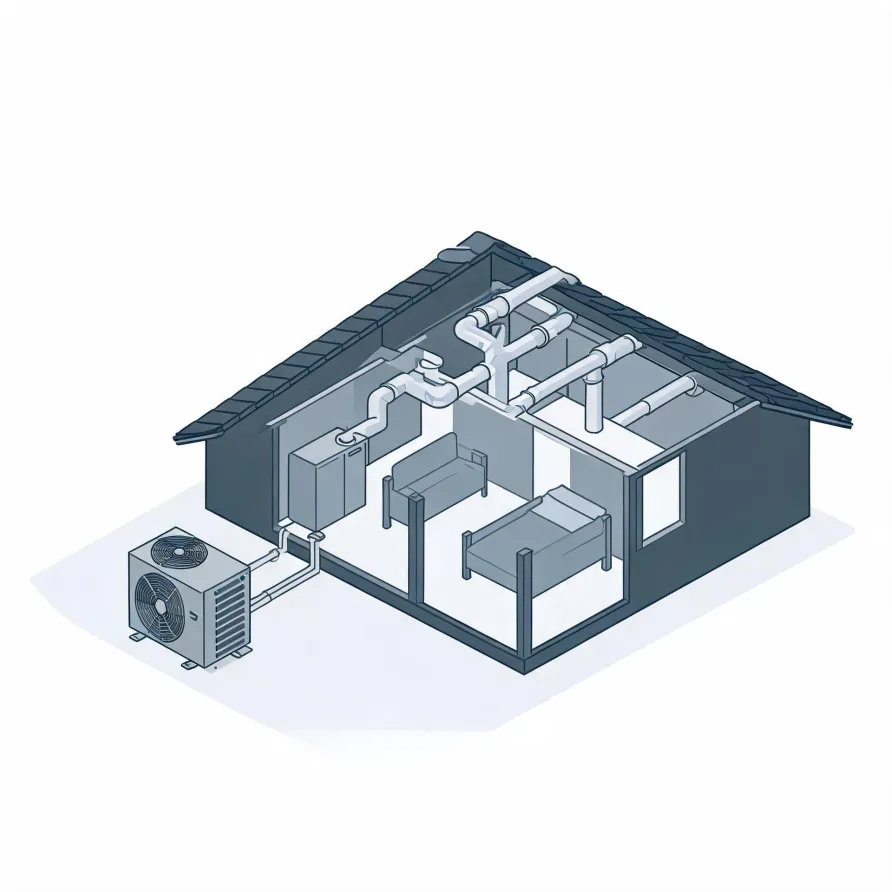
The outdoor unit sits on a concrete pad or mounting bracket outside the house and holds the compressor and one set of coils. The indoor air handler mounts in a closet, attic, or utility space and circulates conditioned air through the home. Together these two units are the core of what a contractor installs.
A refrigerant line set runs between the outdoor unit and the air handler, carrying the working fluid that links the two sides of the system. A thermostat on an interior wall serves as the control point, and a condensate drain line runs from the air handler to a suitable discharge location nearby.
The drawing shows a representative layout, and a licensed contractor determines exactly how each piece applies to your house.
Get matched in Dougherty CountyDougherty County, by the numbers
125 severe weather events were recorded in Dougherty County, Georgia between 2015 and 2024.
NOAA National Centers for Environmental Information, Storm Events Database, bulk CSV export, events 2015-01-01 through 2024-12-31.Half the homes in Dougherty County, Georgia were built in 1975 or earlier (2020-2024 ACS 5-year).
U.S. Census Bureau, 2020-2024 American Community Survey 5-Year EstimatesDougherty County, Georgia holds 40,653 housing units (2020-2024 ACS 5-year).
U.S. Census Bureau, 2020-2024 American Community Survey 5-Year EstimatesOwners occupy 45.3% of the occupied homes in Dougherty County, Georgia (2020-2024 ACS 5-year).
U.S. Census Bureau, 2020-2024 American Community Survey 5-Year EstimatesSevere Weather Events in Dougherty County
Heating and cooling loads are shaped by what the local climate actually does, not what a general spec sheet assumes. A heat pump sized and installed for conditions in Dougherty County has to hold up to whatever this area puts on it.
125 severe weather events, 2015–2024. Source: NOAA National Centers for Environmental Information, Storm Events Database.