Tell us about the job
Takes about a minute. No obligation.
A contractor pricing heat pump repair in Forsyth County has to work out what wore the system down before they can say what it needs. 76 severe weather events were recorded in Forsyth County, Georgia between 2015 and 2024. At that rate, stress on contactors, capacitors, and the refrigerant circuit accumulates steadily, and a technician who skips that history risks replacing a part that will fail again for the same reason. The repair scope follows from what the equipment has actually been carrying.
Recent construction leaves a contractor with a narrower diagnostic problem. Half the homes in Forsyth County, Georgia were built in 2004 or earlier (2020-2024 ACS 5-year). That means much of what runs in these houses was built for conditions close to what it still faces, and when a heat pump fails here, the opened system is more likely to show a worn contactor, a refrigerant issue, or a failed capacitor than a unit so dated that its parts are no longer made. The repair scope turns on what the components actually are, not on the house working against the equipment.
The Parts of a Heat Pump a Contractor Checks First
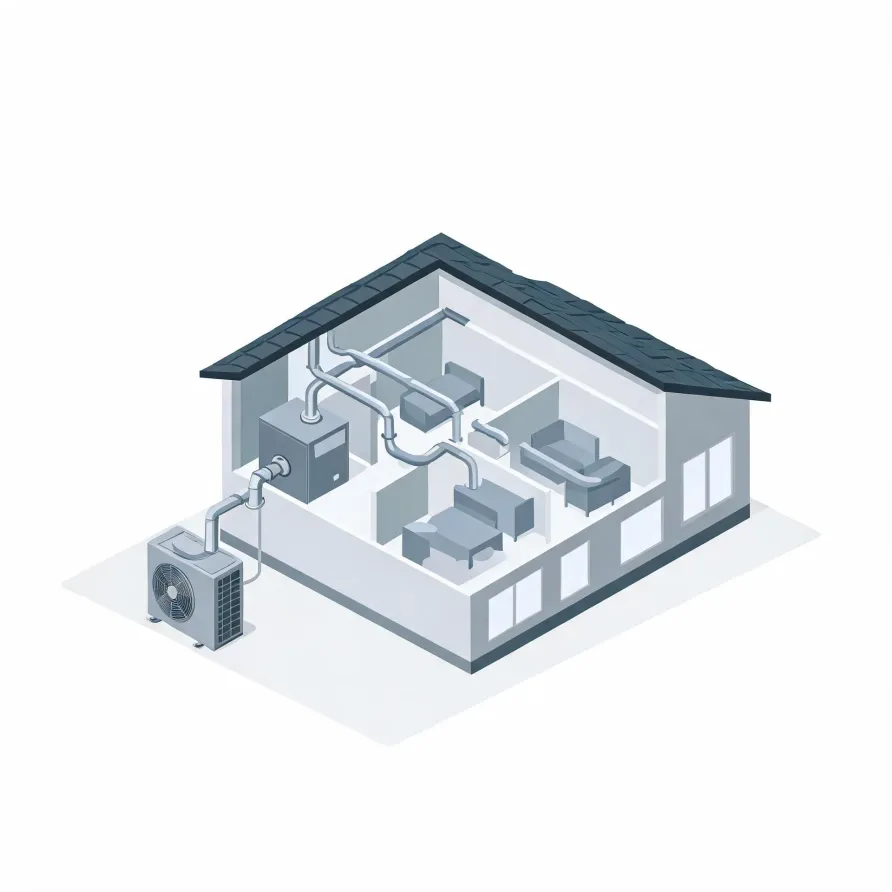
The outdoor unit sits beside the house and holds the compressor and condenser coil. The compressor is the part most often behind a heat pump that has stopped doing its job, and the condenser coil can lose its ability to transfer heat when it is damaged or fouled. A contractor will put hands on both early.
The air handler lives inside, usually in a closet, attic, or utility room, and it contains the indoor coil and the blower that moves conditioned air through the house. The refrigerant lines connect the two units, and the reversing valve inside the system is what tells it to heat or cool. A fault in the valve shows up as a system that runs but delivers the wrong temperature.
The drawing shows a typical layout, and a licensed contractor determines what applies to your specific home and equipment.
Get matched in Forsyth CountyForsyth County, by the numbers
76 severe weather events were recorded in Forsyth County, Georgia between 2015 and 2024.
NOAA National Centers for Environmental Information, Storm Events Database, bulk CSV export, events 2015-01-01 through 2024-12-31.Half the homes in Forsyth County, Georgia were built in 2004 or earlier (2020-2024 ACS 5-year).
U.S. Census Bureau, 2020-2024 American Community Survey 5-Year EstimatesForsyth County, Georgia holds 92,575 housing units (2020-2024 ACS 5-year).
U.S. Census Bureau, 2020-2024 American Community Survey 5-Year EstimatesOwners occupy 84.4% of the occupied homes in Forsyth County, Georgia (2020-2024 ACS 5-year).
U.S. Census Bureau, 2020-2024 American Community Survey 5-Year EstimatesSevere Weather Events in Forsyth County
Extreme weather puts direct stress on heat pump systems, forcing them to run harder and longer than routine conditions require. How much of that stress a unit carries over time shapes what repairs look like and how soon they tend to be needed.
76 severe weather events, 2015–2024. Source: NOAA National Centers for Environmental Information, Storm Events Database.