Tell us about the job
Takes about a minute. No obligation.
A contractor quoting a heat pump repair in Coweta County has to account for the cumulative load on the system before settling on a diagnosis. 221 severe weather events were recorded in Coweta County, Georgia between 2015 and 2024. At that rate, severe weather is a standing condition of operating here, and the parts that carry the system through repeated thermal and electrical stress show it: capacitors, contactors, and refrigerant line connections tend to surface first on a repair inspection. A contractor who skips that check and replaces only what failed visibly may miss what made it fail.
Heat pump systems in houses built around the turn of this century were installed after the refrigerant standards and component lines that contractors work with today were already established. Half the homes in Coweta County, Georgia were built in 1999 or earlier (2020-2024 ACS 5-year). That matters for repair work because when a technician opens a unit and identifies a failed part, what they find is a component from a generation close enough to the present that sourcing a replacement is a real option. The diagnosis turns on the specific condition of what is inside, not on whether the part still exists.
The Parts of a Heat Pump a Contractor Checks First
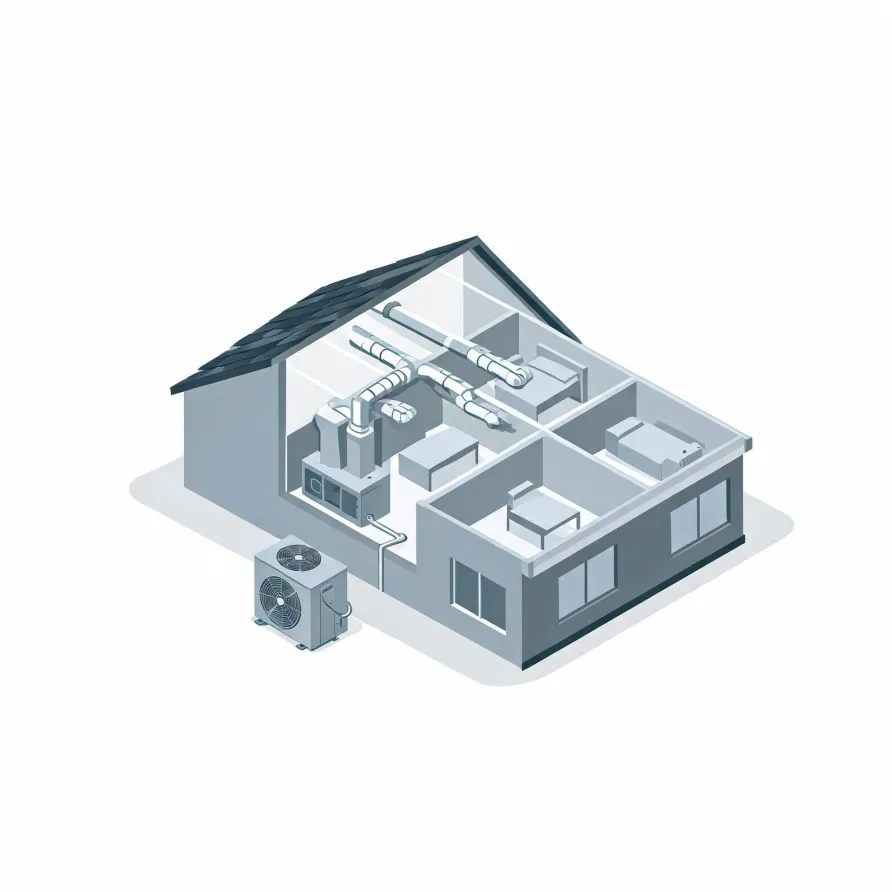
The outdoor unit is usually where a contractor starts. It houses the compressor, which drives the whole system, and the coil that either pulls heat from outside air or releases it there. When that unit is the problem, symptoms show up everywhere: rooms that won't reach temperature, ice on the coil, or the system running without moving any heat at all.
Inside the house, the air handler contains the indoor coil and the blower that pushes conditioned air through the home. Alongside it sits the reversing valve, which is what lets a heat pump heat and cool from the same machine. A refrigerant line set connects the two units, and the expansion valve controls how refrigerant moves between them.
The drawing shows a typical layout, and a licensed contractor determines which components apply to your specific system and house.
Get matched in Coweta CountyCoweta County, by the numbers
221 severe weather events were recorded in Coweta County, Georgia between 2015 and 2024.
NOAA National Centers for Environmental Information, Storm Events Database, bulk CSV export, events 2015-01-01 through 2024-12-31.Half the homes in Coweta County, Georgia were built in 1999 or earlier (2020-2024 ACS 5-year).
U.S. Census Bureau, 2020-2024 American Community Survey 5-Year EstimatesCoweta County, Georgia holds 59,197 housing units (2020-2024 ACS 5-year).
U.S. Census Bureau, 2020-2024 American Community Survey 5-Year EstimatesOwners occupy 78.4% of the occupied homes in Coweta County, Georgia (2020-2024 ACS 5-year).
U.S. Census Bureau, 2020-2024 American Community Survey 5-Year EstimatesSevere Weather Events in Coweta County
Weather puts direct strain on heat pump equipment. Every extreme event a county sees adds to the cumulative load that determines how hard a system works and how soon it needs attention.
221 severe weather events, 2015–2024. Source: NOAA National Centers for Environmental Information, Storm Events Database.