Tell us about the job
Takes about a minute. No obligation.
A heat pump in Worth County has been running against weather that is a regular feature of life here, and that history shows up inside the equipment. 179 severe weather events were recorded in Worth County, Georgia between 2015 and 2024. At that rate, compressor strain, refrigerant line stress, and contactor wear are the first things a contractor checks, because those are the parts that absorb what the weather delivers. A system that has been cycling hard against routine severe conditions will show that load at specific points, and a repair quote that does not start there is starting in the wrong place.
Refrigerant lines corrode and contactors wear on their own schedule, but whether a contractor can close the job in one visit depends on parts availability. Half the homes in Worth County, Georgia were built in 1985 or earlier (2020-2024 ACS 5-year). Equipment installed into housing stock that age has often been swapped or retrofitted more than once, which means the internals a contractor opens may belong to a different generation than the unit's exterior suggests. If the capacitor or reversing valve that failed is from a discontinued product line, the repair waits on a supplier, not on the technician's diagnosis.
The Parts of a Heat Pump a Contractor Checks First
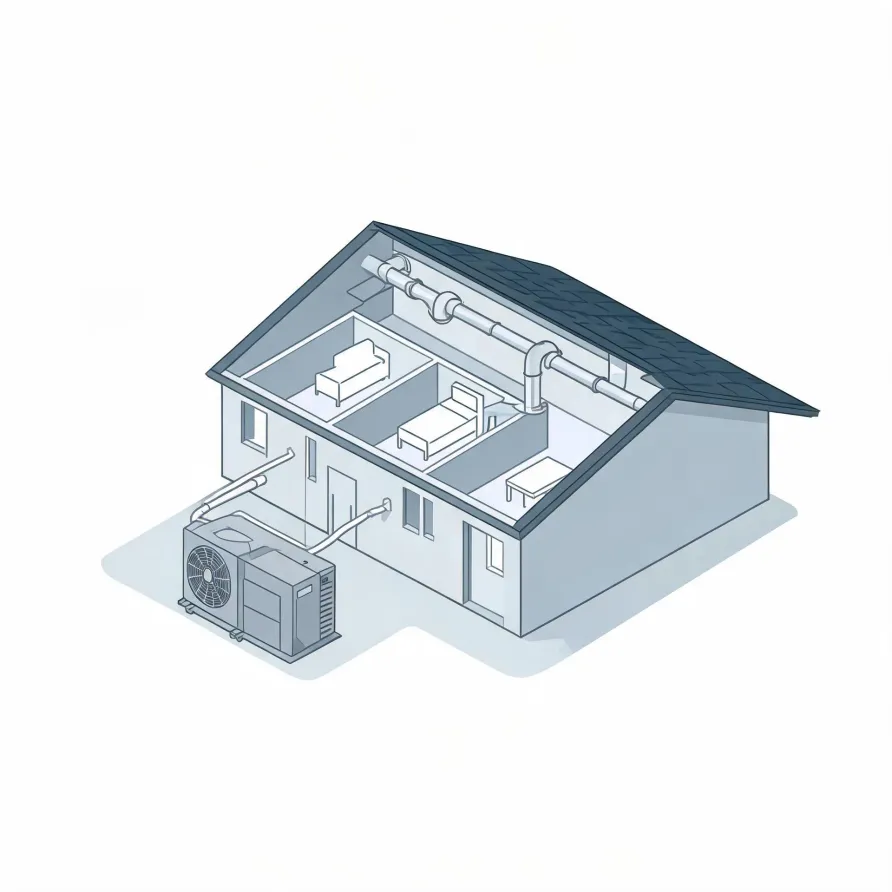
The outdoor unit is usually where a repair starts. It holds the compressor, which drives the whole system, and the coil that exchanges heat with the outside air. When the outdoor unit is the problem, the house stops heating or cooling entirely, or the unit runs but does nothing useful.
Inside the house, the air handler moves conditioned air through the home and contains the indoor coil and the blower. The reversing valve, which sits in the outdoor unit, is what lets a heat pump work in both directions. A failed reversing valve is a common reason a system heats when it should cool, or does neither.
The drawing shows a typical layout, and a licensed contractor determines what applies to your specific system and home.
Get matched in Worth CountyWorth County by the numbers
179 severe weather events were recorded in Worth County, Georgia between 2015 and 2024.
NOAA National Centers for Environmental Information, Storm Events Database, bulk CSV export, events 2015-01-01 through 2024-12-31.Half the homes in Worth County, Georgia were built in 1985 or earlier (2020-2024 ACS 5-year).
U.S. Census Bureau, 2020-2024 American Community Survey 5-Year EstimatesWorth County, Georgia holds 9,326 housing units (2020-2024 ACS 5-year).
U.S. Census Bureau, 2020-2024 American Community Survey 5-Year EstimatesOwners occupy 73.7% of the occupied homes in Worth County, Georgia (2020-2024 ACS 5-year).
U.S. Census Bureau, 2020-2024 American Community Survey 5-Year EstimatesSevere Weather Events in Worth County by Year
Storms and temperature swings put real strain on heat pump systems, pushing them to run harder and longer than steady conditions require. How much stress a unit absorbs over time is a local question, and the weather record for this area is part of the answer.
179 severe weather events, 2015–2024. Source: NOAA National Centers for Environmental Information, Storm Events Database.