Tell us about the job
Takes about a minute. No obligation.
A contractor quoting a heat pump repair in Clayton County works through a different set of questions than one in a quieter area. 51 severe weather events were recorded in Clayton County, Georgia between 2015 and 2024. Severe weather at that rate means a system has been cycling hard through real stress, not occasional mild disruption. Refrigerant lines, capacitors, and the compressor all carry that load over time, and a contractor checking any of them here has to weigh what repeated environmental stress has done before settling on a cause. Age alone does not explain a failure when the operating conditions have been genuinely demanding.
Half the homes in Clayton County, Georgia were built in 1989 or earlier (2020-2024 ACS 5-year). A house that old has seen equipment come and go, and whatever is running now was set into it well after the walls went up. What decides a heat pump repair in stock like this is what a contractor finds once the unit is open: whether the compressor, reversing valve, or refrigerant circuit has worn in a way that takes a part still in production, or one that takes some finding. The building itself is rarely where the answer lives.
The Parts of a Heat Pump a Contractor Checks First
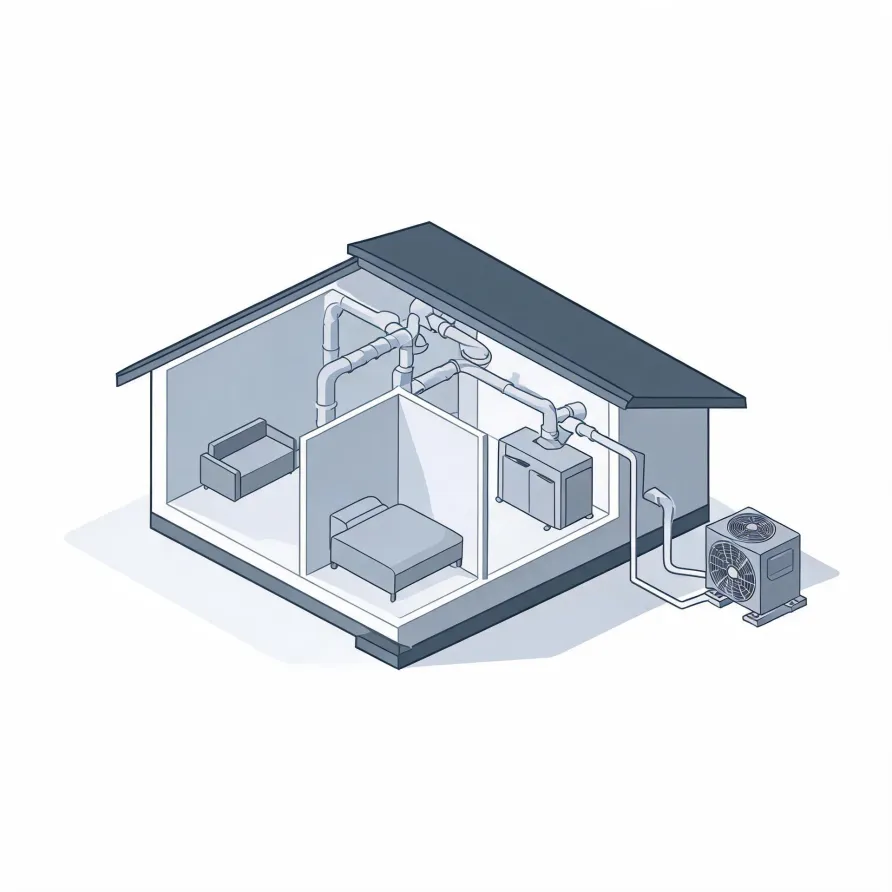
The outdoor unit is where most repair calls begin. It houses the compressor, which is the heart of the system, along with the condenser coil and a fan. When a heat pump stops moving heat or runs constantly without result, the compressor and coil are the first places a contractor looks.
Inside the house, the air handler holds the indoor coil and the blower that pushes conditioned air through the home. The reversing valve, which switches the system between heating and cooling, sits in the outdoor unit and is a common source of faults when the heat pump runs but delivers the wrong temperature.
The drawing shows a typical layout, and a licensed contractor determines which components apply to your specific system and what work each one needs.
Get matched in Clayton CountyClayton County, Georgia, by the numbers
51 severe weather events were recorded in Clayton County, Georgia between 2015 and 2024.
NOAA National Centers for Environmental Information, Storm Events Database, bulk CSV export, events 2015-01-01 through 2024-12-31.Half the homes in Clayton County, Georgia were built in 1989 or earlier (2020-2024 ACS 5-year).
U.S. Census Bureau, 2020-2024 American Community Survey 5-Year EstimatesClayton County, Georgia holds 115,476 housing units (2020-2024 ACS 5-year).
U.S. Census Bureau, 2020-2024 American Community Survey 5-Year EstimatesOwners occupy 54.5% of the occupied homes in Clayton County, Georgia (2020-2024 ACS 5-year).
U.S. Census Bureau, 2020-2024 American Community Survey 5-Year EstimatesSevere Weather Events in Clayton County
Weather puts hours on a heat pump. Every cycle the system runs to recover from an extreme outdoor condition is a cycle that wears the components, and Clayton County's climate drives that load year round.
51 severe weather events, 2015–2024. Source: NOAA National Centers for Environmental Information, Storm Events Database.